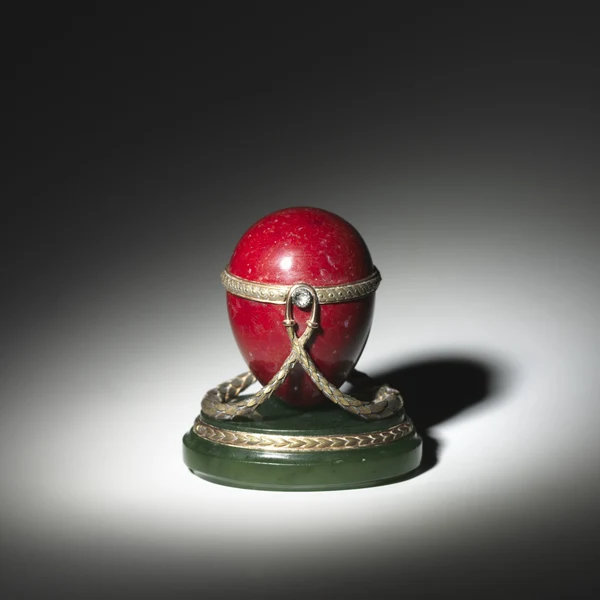
Fabergé Romanov Imperial Nephrite & Enamel Desk Seal (c. 1900)
Commissioned for the Romanov Imperial Family by master jeweler Peter Carl Fabergé, this desk seal unites a carved Siberian nephrite handle with translucent guilloché enamel, chased multi-color gold mounts, and rose-cut diamonds, representing the peak of desktop jewelry.
Epigraphy & Seal Legend
“底座刻有沙俄罗曼诺夫皇室双头鹰徽或沙皇大公私人西里尔花押”
Translation / Meaning: 沙俄皇家罗曼诺夫家族御用印鉴
Historical Origin & Genesis
At the height of the Belle Époque in St. Petersburg, Peter Carl Fabergé served as Court Jeweler to Tsars Alexander III and Nicholas II.
Beyond his legendary Imperial Easter Eggs, Fabergé achieved international acclaim for his "objets de vertu"—luxurious desk accessories including letter openers, desk clocks, and gem-encrusted wax seals.
Tsar Nicholas II, Empress Alexandra Feodorovna, and King Edward VII of the United Kingdom commissioned Fabergé desk seals as personal treasures and diplomatic presentation gifts.
Matrix Craftsmanship & Material Structure
Carved Siberian Nephrite: Sourced from the Sayan Mountains near Lake Baikal, the dark spinach-green jade was hand-carved into ergonomic baluster forms with a soft tactile polish.
Guilloché Enameling: The gold collars feature engine-turned engraving overlaid with translucent vitreous enamel (opalescent oyster, raspberry, or sky blue) fired at 800°C for luminous optical depth.
Workmaster Hallmarks: Stamped with the imperial warrant mark "K. FABERGÉ" in Cyrillic alongside marks of head workmasters Henrik Wigström (H.W.) or Michael Perchin (M.P.), and 56-zolotnik gold standards.
Iconography, Heraldry & Epigraphy
Chalcedony Matrix: Bases in chalcedony or bloodstone were deeply engraved with the Imperial Russian Double-Headed Eagle carrying Saint George slaying the dragon.
Cyrillic Imperial Monograms: Pieces crafted for grand dukes bore entwined Cyrillic monograms (e.g., "NA" for Nicholas and Alexandra) crowned with the Romanov imperial diadems.
Harmonious Textures: The juxtaposition of lustrous nephrite, engine-turned guilloché, and diamond collars created an unprecedented visual symphony.
Provenance, Conservation & Archival History
Following the 1917 Russian Revolution, imperial palaces were nationalized and many treasures dispersed across Western collections via antique auctions and emigré nobles.
The British Royal Collection at Windsor Castle holds one of the world’s greatest repositories of Fabergé desk seals, acquired by Queen Alexandra and Queen Mary.
In international auctions at Sotheby’s and Christie’s, authenticated Fabergé seals complete with original holly-wood presentation boxes command world-record prices.
Collectible Significance & Appraisal Analysis
The Gold Standard of Russian Decorative Art: Fabergé seals transform desktop utility into museum-grade jewelry, unmatched in lapidary precision.
Connoisseurship and Authentication Key Points:
1. Workmaster Assay Marks: Authentic punch marks for Henrik Wigström ("H.W.") or Michael Perchin ("M.P.") are microscopic, crisp, and struck with uniform depth;
2. Enamel Purity: Genuine Fabergé guilloché reveals flawless vitreous flow devoid of air bubbles, clouding, or surface orange-peel ripples;
3. Siberian Nephrite Inclusions: Authentic Sayan nephrite features characteristic micro-crystalline chromite inclusions and a velvety, waxy luster.
Inspired by History: Craft Your Custom 3D Wax Seal
Channel the timeless elegance of classic sigillography. Customize your bespoke wax seal with WebGL physical rendering—start from historical palettes, fine-tune relief height and wax fluidity, and export in 3D GLB.