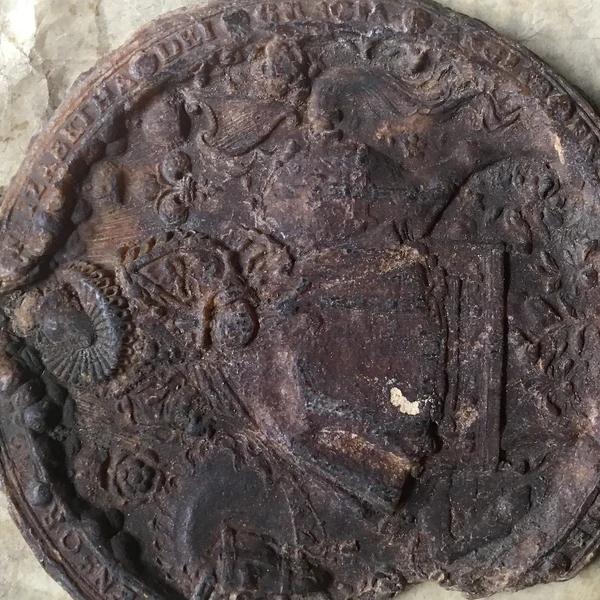
Queen Elizabeth I’s Second Great Seal (1586)
Masterminded by celebrated court limner Nicholas Hilliard, this monumental 145mm double-sided wax seal is universally regarded as the artistic zenith of English sigillography, uniting heraldic grandeur with poetic Renaissance grace.
Epigraphy & Seal Legend
“ELIZABETHA DEI GRACIA ANGLIE FRANCIE ET HIBERNIE REGINA FIDEI DEFENSOR”
Translation / Meaning: 伊丽莎白,蒙神之恩,英格兰、法兰西及爱尔兰女王,信仰捍卫者
Historical Origin & Genesis
By 1584, Queen Elizabeth I had reigned for over a quarter-century. Her initial Great Seal was heavily worn. A royal warrant commissioned court miniaturist Nicholas Hilliard to draft a breathtaking new design.
Hilliard transformed sigillography into haute Renaissance portraiture, infusing the Cult of Gloriana—celebrating the Virgin Queen as an immortal, divinely appointed ruler—into a massive wax matrix.
Engraved at the Royal Mint in the Tower of London, this matrix entered official service in 1586, validating royal charters during the defeat of the Spanish Armada and the Elizabethan literary renaissance.
Matrix Craftsmanship & Material Structure
Monumental Proportions: Spanning an extraordinary 145mm in diameter with a 14mm cross-section, it provided unprecedented depth for multi-layered micro-reliefs.
Layered Relief Virtuosity: Within millimeter tolerances, Hilliard sculpted the intricate starched lace of the royal ruff, pearls encrusting the royal stomacher, and the anatomically precise musculature of the trotting steed.
Wax Refinement: Formulated from triple-filtered beeswax tempered with French rosin and Venice turpentine, yielding a rich walnut-amber tone with a lacquer-like sheen.
Iconography, Heraldry & Epigraphy
Obverse in Majesty: Elizabeth sits enthroned beneath radiant clouds from which divine rays burst forth. She holds the scepter of state and cross orb, flanked by crowned shields of France and England.
Reverse Equestrian: Departing from martial male monarchs in armor, Elizabeth is depicted sidesaddle in court dress, her gossamer mantle billowing behind her as her horse canters across a meadow carpeted with blooming Tudor roses, lilies, and daisies.
First Appearance of the Irish Harp: Alongside the crowned Tudor Rose and French Fleur-de-lis, this seal marks the historic first inclusion of the Irish Harp on an English Great Seal, cementing Tudor tripartite sovereignty.
Provenance, Conservation & Archival History
Original impressions survive in prestigious archival repositories, notably The National Archives at Kew, The British Museum, and the Victoria and Albert Museum.
Intact wax examples remain affixed to momentous historical patents, including Sir Walter Raleigh’s Virginia charters and royal pardons bearing Hilliard’s unmistakable artistic signature.
Because of its unparalleled artistic brilliance, James I briefly retained this matrix following Elizabeth’s death in 1603 until his own Jacobean seals could be cast.
Collectible Significance & Appraisal Analysis
Art Historical Monument: Hilliard’s seal is collected as a masterpiece of Renaissance miniature sculpture on par with his famed portrait miniatures.
Appraisal and Condition Checklist:
1. Facial Features and Ruff Filigree: Due to high relief, the queen’s delicate profile is prone to rub; examples retaining crisp lace apertures command premium tiers;
2. Equestrian Undercutting: The airborne hooves and floral stems require clean definition devoid of secondary wax bubbling;
3. Provenance and Plena: Intact charters with undamaged silk cords and unbroken legends are headline pieces at Sotheby’s and Christie’s antiquities auctions.
Inspired by History: Craft Your Custom 3D Wax Seal
Channel the timeless elegance of classic sigillography. Customize your bespoke wax seal with WebGL physical rendering—start from historical palettes, fine-tune relief height and wax fluidity, and export in 3D GLB.