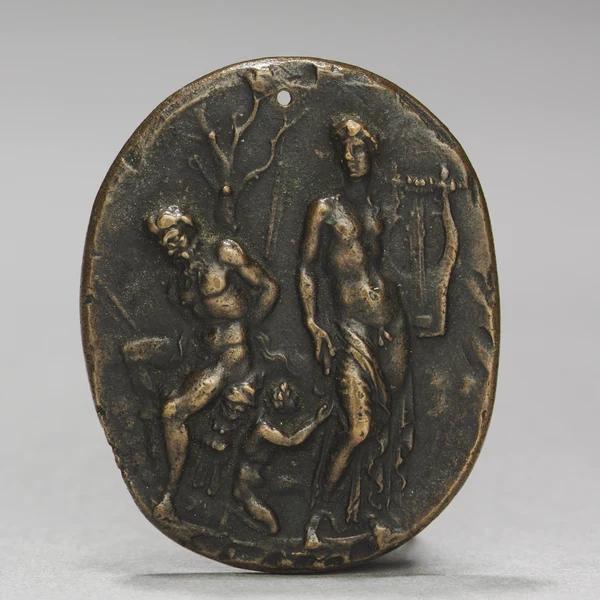
Siegelring Lorenzo de’ Medicis: Apollo und Marsyas
The prized signet ring of Lorenzo the Magnificent (Lorenzo de’ Medici). Carved into glowing carnelian during the Augustan age and mounted for Lorenzo with his personal LAUR. MED. ownership mark, this gem inspired Botticelli, Leonardo, and Michelangelo, embodying the Renaissance revival of Classical antiquity.
Inschrift & Umschrift
“印台加刻家徽私藏铭文:LAUR. MED.(Laurentius Medices,洛伦佐·德·美第奇)”
Übersetzung / Deutung: 洛伦佐·德·美第奇私人珍藏印鉴
Historical Origin & Genesis
In Renaissance Florence, Lorenzo de’ Medici ("Il Magnifico") spearheaded the humanist rebirth of Classical antiquity, amassing the most legendary cabinet of ancient cameos and intaglios in Europe.
The crown jewel of his glyptic collection was this Roman carnelian intaglio, attributed in antiquity to Dioscurides, the celebrated gem-engraver to Emperor Augustus.
Lorenzo had the ancient gem set into a personal gold signet ring, proudly engraving his Latin initials "LAUR. MED." to mark his ownership and seal his personal correspondence.
Matrix Craftsmanship & Material Structure
Translucent Carnelian Intaglio: Carved into deep fiery orange-red chalcedony using iron rotary drills and diamond grit abrasives, achieving astonishing three-dimensional depth in a stone under 3cm wide.
Anatomical Precision in Miniature: The intaglio captures the serpentine grace of Apollo, the strained ribcage and musculature of the bound satyr Marsyas, and the pleading pathos of youthful Olympus.
Cameo Inversion in Wax: When pressed into warm sealing wax, the negative engraving reverses into a magnificent high-relief sculpture with porcelain-sharp contours.
Iconography, Heraldry & Epigraphy
The Myth of Apollo and Marsyas: From Ovid’s Metamorphoses, the satyr Marsyas challenged Apollo to a musical contest; upon losing, he was punished for hubris by being flayed alive. Apollo stands victorious with his lyre, while Marsyas hangs bound to a pine.
Neoplatonic Allegory: To the Medici circle of Marsilio Ficino, this scene symbolized the triumph of divine celestial harmony over earthly, carnal passion, and the painful purification of the human soul.
The LAUR. MED. Ownership Inscription: Lorenzo’s initials proclaimed the Medici not merely as bankers, but as the rightful intellectual heirs to the Roman Empire.
Provenance, Conservation & Archival History
The gem was so universally admired that Renaissance bronze sculptors (such as Cristoforo di Geremia) widely replicated it in bronze plaquettes. Its visual structure directly inspired Botticelli and the young Michelangelo studying in the Medici sculpture garden.
Following the Medici expulsion in 1494, the signet entered the illustrious Farnese collection in Rome, eventually passing to the Bourbon kings of Naples.
Today, this two-thousand-year-old carnelian gemstone rests in the National Archaeological Museum of Naples (MANN) as a masterwork of ancient and Renaissance glyptic art.
Collectible Significance & Appraisal Analysis
The Mona Lisa of Antique Glyptics: The intersection of Augustan Roman intaglio mastery and Medici provenance places this piece in an untouchable tier of world art.
Connoisseurship Guidelines for Ancient Signet Gems:
1. Ancient Intaglio Polishing: Authentic 1st-century BCE Roman cutting features hand-rubbed microscopic polish within the grooves, eliminating harsh tooling chatter;
2. Renaissance Epigraphy: The LAUR. MED. characters exhibit characteristic 15th-century Florentine epigraphic serifs cut with miniature chisels;
3. Carnelian Internal Inclusions: Natural chalcedony displays natural micro-clouding and iron oxide color stratification under transmitted fiber-optic illumination.
Von der Geschichte Inspiriert: Eigenes 3D-Wachssiegel Gestalten
Lassen Sie sich von klassischer Siegelkunst inspirieren. Gestalten Sie Ihr persönliches Wachssiegel im WebGL-3D-Studio: wählen Sie historische Farbpaletten, passen Sie Reliefhöhe und Schmelzfluss an und exportieren Sie als 3D-GLB.