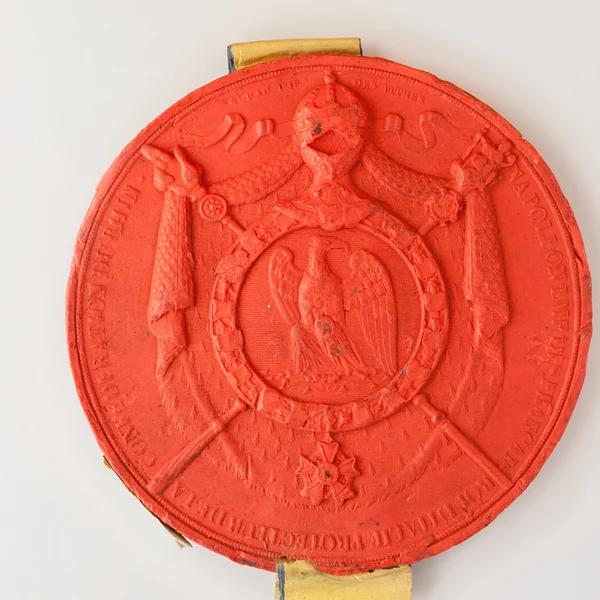
الختم الإمبراطوري العظيم لنابليون الأول (1804–1815)
Commissioned following his 1804 coronation, Napoleon’s Great Seal of the Empire measures 125mm in brilliant scarlet shellac, enclosed in an engraved gilt-brass skippet. It authenticated the Napoleonic Code and dynastic patents across Europe.
النقوش والشعارات التاريخية
“NAPOLÉON EMPEREUR DES FRANÇAIS”
الترجمة والتفسير: 拿破仑,法兰西人的皇帝
Historical Origin & Genesis
Proclaimed Emperor of the French in 1804, Napoleon Bonaparte sought to harmonize Roman imperial gravitas with Enlightenment civil law. He commissioned Louvre Director Vivant Denon to oversee the creation of a monumental Great Seal.
Chief Engraver Nicolas-Guy-Antoine Brenet hand-cut the steel dies, celebrating the newly established Bonaparte dynasty.
Between 1804 and 1815, this Great Seal authenticated foundational monuments of modern jurisprudence—most notably the Napoleonic Code (Code Civil des Français)—as well as treaties altering the map of Europe.
Matrix Craftsmanship & Material Structure
Imperial Vermilion Formula: Manufactured from imported shellac and high-grade cinnabar pigments, producing a brilliant enamel-hard disc 125mm wide and 10mm thick.
Chased Gilt Skippet: To safeguard the brittle wax, it was poured directly into a heavy gilt-brass skippet fitted with a screw cover bearing the relief of the imperial eagle.
Tricolor Silk Ribbons: Ribbons in the French national tricolor (or imperial crimson and green) were embedded within the hot wax, binding the vellum patent permanently to the seal box.
Iconography, Heraldry & Epigraphy
Obverse: Napoleon is depicted in classical Roman splendor, crowned with laurel wreaths, enthroned in coronation robes embroidered with imperial bees, grasping the Hand of Justice and the scepter of Charlemagne.
Reverse: The Napoleonic Eagle—modeled on Roman legionary standards—clutches thunderbolts in its talons, enveloped by the grand collar of the Légion d’Honneur against imperial ermine drapery.
The Golden Bees: Rejecting the Bourbon fleur-de-lis, Napoleon adopted the golden bee motif excavated from the 5th-century tomb of Merovingian King Childeric I, establishing genealogical primacy older than the Capetians.
Provenance, Conservation & Archival History
The French National Archives in Paris and the Château de Fontainebleau preserve splendid exemplars attached to historic land grants and marshals’ commissions.
During the dramatic Hundred Days (1815), Napoleon ordered an urgent, modified profile matrix, creating an exceedingly rare sigillographic variant prized by specialists.
Letters patent retaining intact gilt-brass skippets and pristine vermilion wax represent the pinnacle of Napoleonic collecting at international auction houses.
Collectible Significance & Appraisal Analysis
The Crown of Modern Historic Sigillography: As the physical imprint behind civil codification, this artifact commands commanding sums among international institutions.
Authentication and Connoisseurship Guidelines:
1. Skippet Integrity: Genuine pieces retain the original gilt-brass container with period threading and uncompromised internal adhesion;
2. Micro-Signature: Brenet’s microscopic maker mark beneath the thunderbolts separates period impressions from later 19th-century electrotypes;
3. Conchoidal Shellac Fracture: Two-century-old shellac displays telltale conchoidal micro-fracturing along rim edges, never the plastic softness of synthetic polymer casts.
مستوحى من التاريخ: صمم ختم الشمع المخصص في استوديو 3D
استحضر أصالة فنون الأختام الكلاسيكية. صمم ختمك الخاص عبر استوديو المحاكاة الفيزيائية WebGL: انطلق من درجات الألوان التاريخية، وخصص عمق النقوش ثم قم بالتصدير بصيغة 3D GLB.