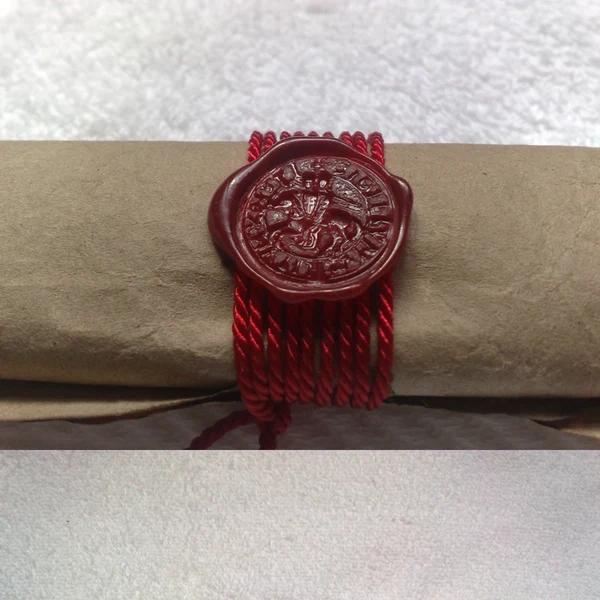
ختم فرسان الهيكل (ختم جند المسيح)
The iconic seal of the Poor Fellow-Soldiers of Christ and of the Temple of Solomon. The obverse depicts two armored knights sharing a single horse—embodying their vow of poverty and mutual brotherhood—while the reverse portrays the Dome of the Rock, re-imagined as Solomon’s Temple.
النقوش والشعارات التاريخية
“SIGILLUM MILITUM XPISTI”
الترجمة والتفسير: 基督战友之印(XPISTI采用希腊字母Chi-Rho缩写)
Historical Origin & Genesis
Founded circa 1119 by Hugues de Payens and eight companions to protect Christian pilgrims in the Holy Land, King Baldwin II of Jerusalem granted them quarters on the Temple Mount.
As the Order expanded across Europe into diplomacy and transcontinental banking, the Grand Master required a universally recognized sigil to validate treaties, papal briefs, and credit transfers.
By the tenure of Grand Master Bertrand de Blanchefort (c. 1160), the design featuring two knights on a single mount was officially codified, stamped across Europe and the Outremer.
Matrix Craftsmanship & Material Structure
Dual-Medium Architecture: Local administrative letters utilized vermilion beeswax, whereas solemn maritime treaties across the Levant utilized cast lead bullae (30–50 grams) immune to sea moisture.
Bilingual Christogram: The Latin inscription SIGILLUM MILITUM XPISTI strategically incorporates the Greek letters Chi (X) and Rho (P) for Christ—the ancient Constantinian monogram.
Expeditionary Portability: Measuring a compact 42–48mm, matrices were engineered for battlefield chancelleries, carried securely by the Grand Master’s personal retinue.
Iconography, Heraldry & Epigraphy
Two Knights on One Steed: Sigillographers interpret this iconic emblem as a proud homage to the founders’ vow of poverty—having but one horse between two brothers—or as an allegory of knight and monk, fighting side by side in sacred fraternity.
The Temple of Solomon: The counter-seal depicts the octagonal Dome of the Rock, venerated by Crusaders as Templum Salomonis, surmounted by a cross and classical portico.
Spiritual Duality: Echoes the Order’s black-and-white war banner (Beaucent)—black symbolizing wrath toward pagan enemies, white reflecting spiritual purity before the Almighty.
Provenance, Conservation & Archival History
On Friday, October 13, 1307, King Philip IV of France arrested the Templars. The Paris Temple archives were confiscated, preserving authentic seal impressions in royal accounts.
Preeminent surviving impressions reside in the Archives nationales de France in Paris and The British Museum. The Vatican Secret Archives’ discovery of the Chinon Parchment in 2001 shed further light on original Templar sigillography.
Following Pope Clement V’s dissolution of the Order in 1312, official matrices were broken and melted, rendering surviving medieval impressions legendary rarities.
Collectible Significance & Appraisal Analysis
Holy Grail of Chivalric Collectibles: Medieval Templar sigils sit at the absolute pinnacle of Crusader numismatics and glyptics, commanding fierce competitive bidding.
Appraisal and Verification Matrix:
1. Natural Lead Carbonate Patina: Authentic 13th-century lead bullae feature dense, powdery bone-white or pearlescent patina resulting from centuries of subterranean calcification;
2. Epigraphic Nuances: Counterfeits often misjudge the archaic open loop of the Lombardic-Greek "P" in XPISTI;
3. Internal Cord Lumen: Authentic bullae reveal the central channel through which the linen cords passed, often containing fossilized fiber traces.
مستوحى من التاريخ: صمم ختم الشمع المخصص في استوديو 3D
استحضر أصالة فنون الأختام الكلاسيكية. صمم ختمك الخاص عبر استوديو المحاكاة الفيزيائية WebGL: انطلق من درجات الألوان التاريخية، وخصص عمق النقوش ثم قم بالتصدير بصيغة 3D GLB.