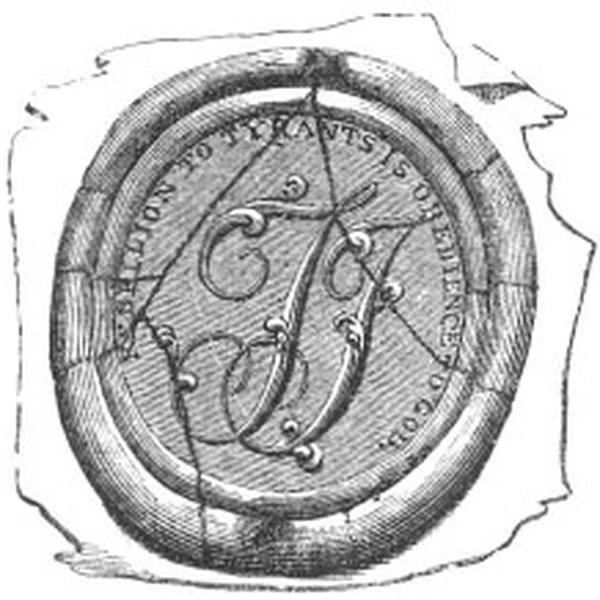
Личная сургучная печать Томаса Джефферсона (1790)
Crafted with the rallying motto proposed by Benjamin Franklin and embraced by Thomas Jefferson: "Rebellion to Tyrants is Obedience to God." Featuring Jefferson’s entwined initials "TJ", this personal wax seal closed thousands of letters shaping American democracy.
Надпись и легенда печати
“REBELLION TO TYRANTS IS OBEDIENCE TO GOD”
Перевод и толкование: 反抗暴政即是服从上帝
Historical Origin & Genesis
On July 4, 1776, the Continental Congress tasked Thomas Jefferson, Benjamin Franklin, and John Adams with designing the Great Seal of the United States.
Franklin proposed an allegorical scene of Moses parting the Red Sea with Pharaoh drowning, paired with the motto: "Rebellion to Tyrants is Obedience to God." While Congress ultimately chose the Bald Eagle design years later, Jefferson adopted the motto as his sacred personal compass.
Around 1790, while serving as the nation’s first Secretary of State, Jefferson commissioned this private desk seal matrix. Centering his script cipher "TJ" within the circular motto, he sealed thousands of letters defining constitutional liberty.
Matrix Craftsmanship & Material Structure
Oval Hardstone Intaglio: Engraved into fine-grained carnelian/onyx hardstone set into an oval bezel 26mm in length, cut with razor-sharp lapidary micro-lettering.
Neoclassical Desk Handle: Mounted on a turned mahogany or baluster-form brass handle weighted for balanced, vertical stamping pressure.
Monticello Epistolary Ritual: Jefferson’s daily desk setup included a spirit lamp and silver melting ladle, using rich dark crimson sealing wax to secure letters written with polygraph copy machines.
Iconography, Heraldry & Epigraphy
Philosophical Lineage: Tracing roots to 17th-century regicide epitaphs, Franklin and Jefferson recast the phrase into an Enlightenment axiom: tyranny violates natural law, making rebellion an act of obedience to divine truth.
Intertwined "TJ" Monogram: The central cipher intertwines the initials in fluid neoclassical calligraphy, reflecting the intellectual elegance of the Sage of Monticello.
Republican Austerity: Intentionally absent are European coronets, crests, or feudal beasts, championing the unadorned democratic ethos of the early American Republic.
Provenance, Conservation & Archival History
Jefferson affixed this seal to correspondence with James Madison, John Adams, the Marquis de Lafayette, and George Washington. Surviving wax impressions reside in the Library of Congress and the National Archives.
Following his death on July 4, 1826, the seal descended through family heirs before acquisition by the Thomas Jefferson Foundation at Monticello.
The matrix remains on permanent view at Monticello in Charlottesville, Virginia, displayed alongside his writing desk and books.
Collectible Significance & Appraisal Analysis
Holy Grail of Early Americana: Intact Jeffersonian wax impressions serve as crucial forensic proof verifying the originality and integrity of foundational letters.
Authentication and Connoisseurship Guidelines:
1. Letter Spacing and Arc Geometry: The 38 capital letters encircle the oval with mathematical balance, separated by tiny punctuation rosettes;
2. Chemical Signature: Spectroscopic studies show Jefferson favored high-grade European vermilion shellac that oxidized to deep port-wine crimson;
3. Rag-Paper Penetration: Stamped on 18th-century handmade linen rag paper, genuine impressions reveal microscopic hot-wax wick penetration through the reverse paper fibers.
Вдохновлено историей: создайте персональную сургучную печать в 3D
Воплотите вневременную эстетику классической сфрагистики. Смоделируйте собственную печать в веб-студии с физическим рендерингом WebGL: отталкивайтесь от исторических палитр, настраивайте рельеф и экспортируйте в 3D GLB.