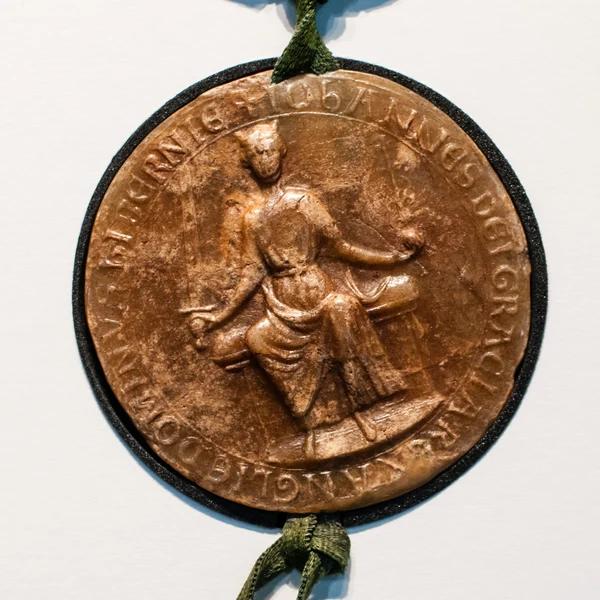
1215년 잉글랜드 존 왕의 대국인 (마그나 카르타 현수 인장)
On June 15, 1215, at Runnymede, King John did not sign Magna Carta with a pen; rather, his Great Chancery appended this massive double-sided beeswax seal. It affirmed that even the sovereign is subject to the rule of law. Surviving copies remain the holy grail of legal history.
인면 명문과 역사적 교훈
“IOHANNES DEI GRACIA REX ANGLIE DOMINUS HIBERNIE DUX NORMANNIE ET AQUITANNIE COMES ANDEGAVIE”
해석 및 고증:约翰,蒙神之恩,英格兰国王,爱尔兰领主,诺曼底与阿基坦公爵,安茹伯爵
Historical Origin & Genesis
In June 1215, faced with a rebellion of northern barons over ruinous taxation and lost continental campaigns, King John negotiated the Great Charter of Liberties at Runnymede meadow near Windsor.
Medieval constitutional law did not recognize a handwritten signature as legally binding; solemn charters required the impression of the sovereign’s Great Seal (Magna Sigillum) under the authority of the Chancery.
John’s Great Seal was cast by pouring heated beeswax tempered with Venice resin into heavy silver dies. Suspended via woven silk braids through vellum slits, the double-sided pendant seal conferred permanent sovereign authority.
Matrix Craftsmanship & Material Structure
Material Composition: Hand-blended natural unbleached beeswax tempered with 30% Venice turpentine and fine chalk filler, yielding a disc 100mm in diameter and over 12mm thick, weighing nearly a quarter kilogram.
Two-Part Casting Matrix: The obverse and reverse silver dies were aligned with dowel pins. Warm wax dough was compressed under substantial screw or lever pressure, capturing the intricate Romanesque drapery and lettering.
Plica Lacing: The bottom margin of the vellum charter was folded into a reinforced hem (plica), pierced with knife slits. Braided red and green silk cords were embedded directly inside the warm wax disc, rendering extraction impossible without destroying the seal.
Iconography, Heraldry & Epigraphy
Obverse in Majesty: King John sits enthroned upon a curule bench, crowned and attired in flowing royal tunics. In his right hand he elevates an unsheathed broadsword representing royal justice; in his left, he cradles the orb and cross (globus cruciger) signifying temporal and spiritual authority.
Reverse Equestrian: The king appears in martial splendor as a knight in chainmail hauberk and great helm, spurring his warhorse into full gallop. He bears a heater shield emblazoned with the three lions passant guardant of the Plantagenets.
This double-sided iconographic pairing established the quintessential medieval template: the monarch as civil lawgiver on the obverse, and military defender of the realm on the reverse.
Provenance, Conservation & Archival History
Of roughly forty original exemplars dispatched across English shires in 1215, only four survive today: two in the British Library, one in Lincoln Cathedral, and one in Salisbury Cathedral.
The British Library exemplar (Cotton MS Augustus II.106) is the sole surviving 1215 charter still physically bearing King John’s seal. During the catastrophic Cotton Library fire at Ashburnham House in 1731, intense radiant heat melted the beeswax into a blackened, shrunken talisman.
Though the surface relief was distorted by flame, this scorched wax relic is revered worldwide as the physical seal that gave birth to constitutional governance and habeas corpus.
Collectible Significance & Appraisal Analysis
The Pinnacle of Legal Sigillography: As the physical seal of Magna Carta, this artifact is virtually priceless. In international auctions, any authentic 13th-century charter bearing an unfragmented Great Seal of John easily commands record-breaking valuations.
Authentication Criteria for Collectors:
1. Wax Craquelure and Patina: Authentic 13th-century beeswax exhibits characteristic deep-amber to blackened oxidation, concentric shrinkage fissures, and sub-surface resinous micro-crystallization;
2. Parchment Stress and Plica Wear: Genuine pendant seals cause telltale elongation of the punched vellum holes and gentle fiber abrasion on the suspension ribbons;
3. Epigraphy: The legend utilizes authentic early Lombardic majuscules with hand-cut punch quirks distinctive to the 13th-century Royal Mint engravers.
역사에서 얻은 영감: 3D 스튜디오에서 나만의 실링 인장 제작
역사적 명인의 고전적인 아름다움을 담아보세요. WebGL 물리 기반 렌더링 스튜디오에서 맞춤형 인장을 디자인하고, 역사적 색상과 질감을 바탕으로 부조 높이를 조정하여 3D GLB로 내보내세요.