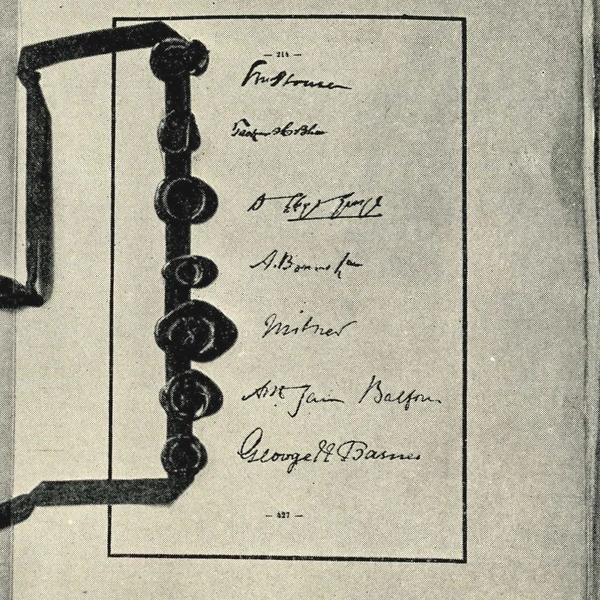
أختام الشمع لمعاهدة فرساي (1919)
Concluded on June 28, 1919, in the Hall of Mirrors at Versailles, the signature page features an extraordinary matrix of vermilion wax seals. American President Woodrow Wilson, British Prime Minister David Lloyd George, and French Premier Georges Clemenceau each impressed their personal signets into molten wax ribbons, marking the historic culmination of diplomacy sealed in wax.
النقوش والشعارات التاريخية
“签署结语条款:IN FAITH WHEREOF the Plenipotentiaries have signed and affixed their seals”
الترجمة والتفسير: 为此,全权代表签字并加盖其火漆印章以昭信守
Historical Origin & Genesis
On June 28, 1919, the Allied and Associated Powers gathered in the Hall of Mirrors at Versailles to sign the treaty concluding the Great War, five years to the day after the assassination of Archduke Franz Ferdinand.
Diplomatic protocol dictated that formal treaties required both signatures and personal seals: "In faith whereof the Plenipotentiaries have signed and affixed their seals."
Even in the modern 20th-century era of typewriters and telegraphs, the French Foreign Ministry insisted on the timeless gravitas of hot red wax, ensuring every signatory sealed the peace.
Matrix Craftsmanship & Material Structure
French Diplomatic Vermilion Wax: The Protocol Office provided pure scarlet shellac wax sticks, melted over alcohol lamps and applied beside each plenipotentiary’s signature.
Ribbon-Woven Binding: The hot wax captured the French national tricolor silk ribbons threading the vellum signatures together.
A Mosaic of Signets: The seals form a fascinating sociological panorama: European aristocrats stamped heraldic signet rings, American delegates used initials, and hurried officials improvised with consular stamps.
Iconography, Heraldry & Epigraphy
Signatures of the Big Four:
• Woodrow Wilson: stamped a tailored oval signet bearing his monogram cipher; • David Lloyd George: utilized a Welsh-inspired personal crest; • Georges Clemenceau ("The Tiger"): stamped an unpretentious, resolute signet reflecting the Third Republic.
The Metaphor of Blood and Peace: The matrix of crimson wax discs against aged parchment stood as a poignant physical testament to the millions who perished on the Western Front.
Provenance, Conservation & Archival History
The official original treaty documents are preserved in the climate-controlled vaults of the Archives diplomatiques de France at La Courneuve, Paris.
Evacuated ahead of the Nazi invasion in 1940, the treaty survived World War II intact, its scarlet seals retaining exceptional relief fidelity.
Following the 1945 UN Charter, multilateral diplomacy adopted embossed blind stamps and printed signatures, establishing Versailles as the twilight monument of sealing wax diplomacy.
Collectible Significance & Appraisal Analysis
Monuments of 20th-Century Diplomatic History: While the master treaty remains inalienable French state heritage, signed diplomatic credentials and plenipotentiary briefs from Versailles command immense interest.
Forensic Authentication Criteria:
1. Ribbon Immersion Mechanics: On-site pouring created natural undulating wax perimeters, wicking completely through the silk weave;
2. Spatial Layout: Each seal sits consistently 1–2cm to the right of the ink signature without overlapping iron gall ink strokes;
3. Parchment Preservation: Heavy handmade vellum shows gentle parchment cockling around the dense shellac discs.
مستوحى من التاريخ: صمم ختم الشمع المخصص في استوديو 3D
استحضر أصالة فنون الأختام الكلاسيكية. صمم ختمك الخاص عبر استوديو المحاكاة الفيزيائية WebGL: انطلق من درجات الألوان التاريخية، وخصص عمق النقوش ثم قم بالتصدير بصيغة 3D GLB.